Quebec’s new blueprint: How the province is solving the multi-family charging puzzle
With two major changes in just the past month, Quebec is quietly delivering on its 2023 promise to revolutionize charging in multi-family dwellings and, in the process, has created a model incentive framework for the rest of the country to follow.
The updates are two-fold, focusing on stopping the growth of the infrastructure gap and minimizing the burden of making existing buildings EV-ready.
Guaranteeing EV-readiness in new construction
After September 26, 2026, all new builds will require dedicated basic infrastructure for L2 EVSE. During the design phase, a formal plan must be developed to ensure that capacity exists to electrify each parking space, excluding visitor spots.
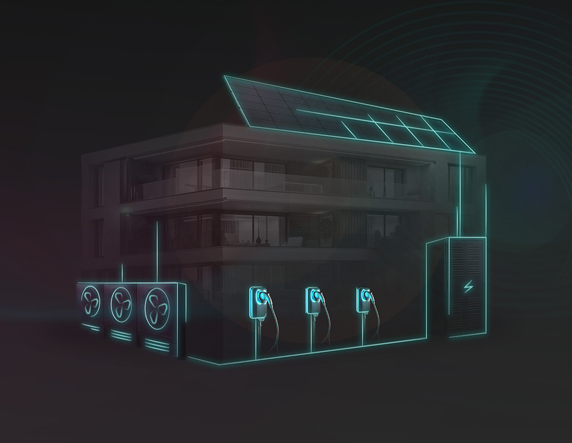
It’s a welcome move for improving access to EV charging, but it also makes electric vehicle energy management systems (EVEMS) critical additions for these new properties.
Where EVEMS is included, EVSE load can be omitted from total demand calculations, provided appropriate monitoring and controls occur.
This offers a significant advantage for both developers and end users. Because EVEMS can ensure that these new EV-ready requirements do not require upgrading to a more expensive, high-capacity new transformer, developers, building operators, and end-users can save significant amounts of money on the electrical infrastructure required to power charging stations at the property.
Solving the problem of adding charging stations to existing buildings
Capping the growth of the infrastructure problem is an important evolution in provincial policy. However, significant attention has also been paid to the existing problem of insufficient capacity and charging in MURBs, with new funding for various initiatives tied to scoping and installing EV charging stations at existing properties.
Funding for design and feasibility assessments
Developers, condo boards, and property managers can receive up to 75% of the cost (up to $5,000) of:
- Analysis and advisory services supporting charging station design
- Energy & feasibility assessments
- And other professional services related to installing EV charging.
To be eligible, these services must come from an organization established in Quebec.
Though important, applicants are not required to take this initial step, and indeed can proceed with applying for support of infrastructure upgrades to enable EV charging in their complexes.
Funding for installing chargers or achieving EV-capable or EV-ready status
Under the ÉcoRecharge program, properties can receive funding amounting to up to 50% of costs, capped at $120,000 per building. Note that buildings constructed after September 26, 2026, will not be eligible for infrastructure subsidies due to the new mandatory building code being in force.
Eligible expenses under this program can include:
- “EV Capable” Work: Installation of junction boxes/conduits and oversizing panels for future use.
- “EV Ready” Work: Full installation of cables and breakers so stations can be connected immediately.
These efforts can occur as one project or in sequence. However, if “EV-Capable” infrastructure is subsidized, a proponent cannot also receive financial support to upgrade to EV-ready later on.
Support also extends to the purchase of qualifying connected L2 EV charging stations, as listed on the Ecorecharge Website, with a minimum acquisition cost of $600. Stations must be kept in service for at least three years.
Also of note, leased stations are eligible! These stations must be purchased from a Canadian retailer.
Additional scenarios the government will fund
Finally, the government has accounted for two additional scenarios, each of which plays a role in solving the issue of inadequate charging access:
Support for a piecemeal charging support option, where a broader solution isn’t applicable or appropriate. This includes:
- $600 for the charging station.
- 50% of eligible installation and infrastructure costs.
- Capped at $5,000.
- Note: Residents must provide proof of EV ownership.
Under this scenario, a tenant at a property that will not install EV charging is empowered to pursue the installation of EV charging on their own, with funding provided to see their charging station get installed. While not ideal – a holistic solution is preferred – this empowers the lone EV trailblazer against the reluctant condo board.
And futureproofing, with developers eligible to receive subsidies to install chargers at properties where residents do not yet own EVs, in anticipation of future demand.
Reinforcing a leadership position in EV adoption
Long one of the national leaders in EV vehicle adoption, with these changes, Quebec is now also staking out one of the most ambitious positions in the country from the perspective of improving access to EV charging for all.
With the impending arrival of more affordable EVs from Chinese manufacturers, the timing couldn’t be better. Two of the biggest barriers to EV adoption—affordability and at-home charging—are about to fall away for a huge portion of the population, likely leading to continued success in electrifying the province’s automotive fleet and a new model to emulate when considering how best to usher in a new era in clean mobility.
A well-deserved kudos go out to the Government of Quebec and the dedicated officials in the Ministère de l’Environnement, de la Lutte contre les changements climatiques, de la Faune et des Parcs for all of their hard work in creating these programs.
Ready to secure funding through Quebec’s ÉcoRecharge program?
Contact SWTCH today to start planning your project!