Index
Why Hideaway Inns Adopted EV Charging as a New Standout Amenity
The operating principle behind Hideaway Inns is clear: give guests what they actually want. Instead of leaning into gimmicks or charging inflated prices for the bare minimum, the brand seeks to deliver thoughtful design, warm hospitality, and the amenities that matter most to the people walking through the door.
For a growing number of those guests, that means ensuring there’s a place to plug in EVs when they arrive.
Hideaway Inns, part of the Revival Hotels family, launched its first property in Mt. Sunapee, New Hampshire, in late September 2025. By March 2026, the brand had opened its second and third locations in Mt. Snow, Vermont and Lenox, Massachusetts, with several more on the way by year’s end.
Already, across all its properties, EV charging is becoming a defining part of the guest experience. To ensure future success, Hideaway knew it would need to find a partner that could assist it with giving drivers a place to plug in, preparing for future scaling, and ensuring that charging feels like an extension of the Hideaway experience, not just a tacked-on extra.
Key Takeaways
- Hideaway Inns, a boutique brand expanding across the Northeast, partnered with SWTCH to bring EV charging to all of its properties.
- What started as a practical need — a colleague struggling to find chargers between hotel sites — became a core guest amenity and brand differentiator.
- With two SWTCH chargers already live at Mt. Snow, Vermont and additional installations planned in Lenox, Massachusetts and Sugar Hill, New Hampshire, Hideaway plans to equip every new property with SWTCH chargers as it scales from three hotels to nine by the end of 2026.
A Different Approach to Northeast Hospitality
By design, Hideaway Inns do not feel like chain properties. Each location has one-of-a-kind room designs, curated communal spaces, and details that reflect the character of the surrounding community. The Lenox property, for example, is an 1860s house revived as a boutique hideaway in the heart of the Berkshires.
Owen Wexman, Director of Marketing Strategy for Hideaway Inns, describes the brand through four core pillars: easy access to everything a guest needs, distinctive design, down-to-earth pricing, and amenities guests actually want. That last pillar is where EV charging fits in.
“Our guests typically come from cities and suburbs,” says Owen. “A lot of them are driving electric cars. EV charging is just super important, especially for the people we want to serve.”
The target guest is often a young family or older millennial looking for a weekend escape in ski country or the mountains—both demographics that prioritize sustainability. They also value authenticity over flash and expect the basics to be done well, looking for things like fast Wi-Fi, quality coffee, and, increasingly, a place to charge overnight.
That expectation reflects a broader shift in hospitality: industry research shows that nearly one in five hotel guests now considers EV charging a must-have, and Hilton reports that has become the top-converting amenity online.
From a Colleague’s Frustration to a Brand Commitment
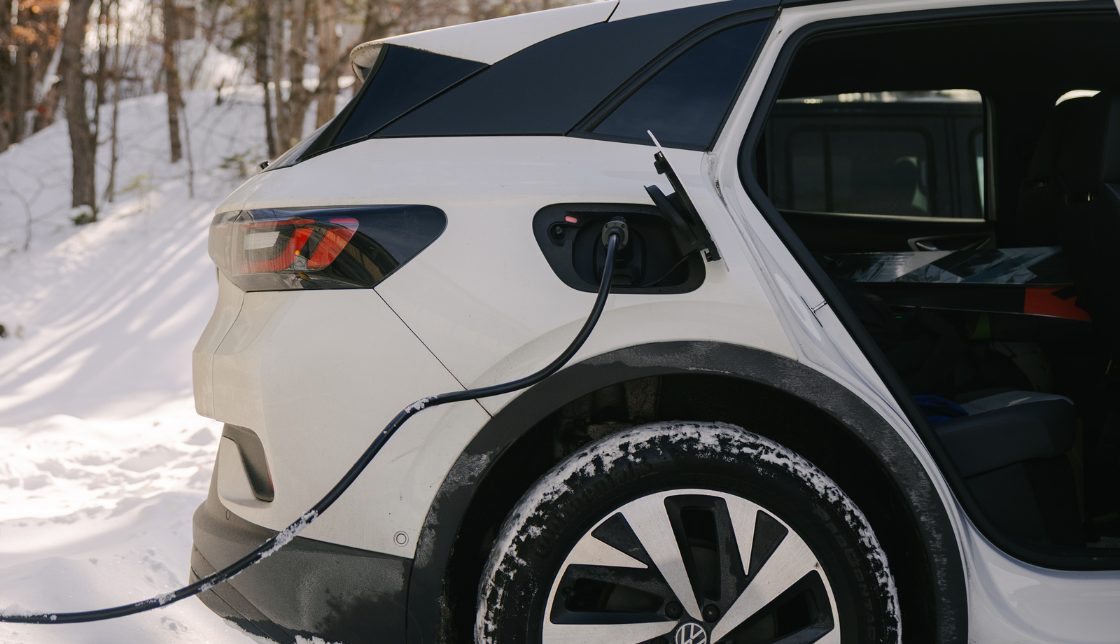
There was no single corporate strategy meeting that put EV charging on Hideaway’s roadmap. Instead, the push began with something simpler: a colleague’s daily frustration. A member of the Hideaway team drives an EV and regularly travels between Hideaway properties in rural Vermont, New Hampshire, and Massachusetts. Finding a reliable charger in those areas was a recurring headache.
That practical need converged with a broader conviction. Hideaway’s Inn’s locations sit in communities that depend on outdoor recreation — skiing, hiking, mountain biking. The team felt a responsibility to support sustainability where they could, and EV charging was an accessible way to do it. It also happened to be exactly what their guests were asking for. Emails requesting EV charging came in regularly, and the amenity began appearing in online inquiries before guests even booked.
But Hideaway was clear from the start about what EV charging should and should not be. It’s not a revenue play, but an amenity — a reason to choose Hideaway over the competition. As Owen put it, “Our guests want this. We want this. The goal is not to nickel and dime them. It really is more of an amenity.”
Finding an EV Charging Partner That Understood Hideaway’s Needs
Deciding to offer EV charging was easy. Finding the right vendor was harder. Several providers were evaluated, but many were either focused on high-traffic urban environments or priced well beyond what a small hotel brand could justify.
Other vendors brought different frustrations: slow communication, a lack of flexibility, or little understanding of what a small hospitality business actually needs.
When SWTCH entered the picture through a referral, the dynamic changed immediately. Projects began to proceed in line with Hideaway’s vision and requirements, and when one site’s quote came in higher than expected, the SWTCH team found alternative local partners and reworked the approach to bring prices back down.
Reflecting on the decision to work with SWTCH, Owen said, “It was less so the machine and more so the people. Just easy, good service. We had questions or problems, and SWTCH was quick to respond.”
Chargers Live and Turning Heads
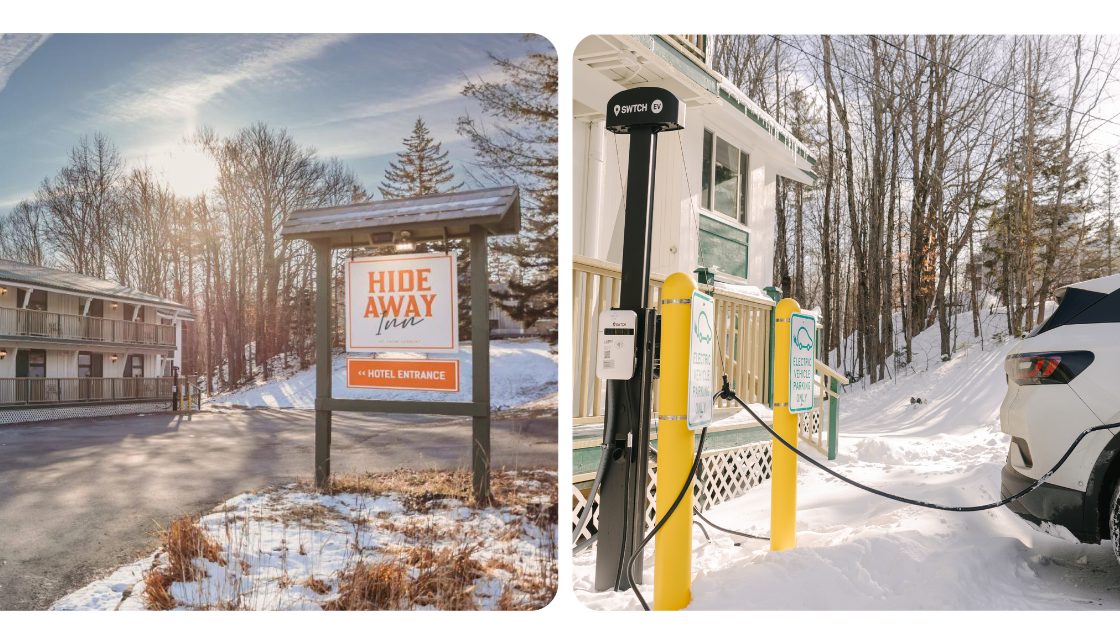
As of spring 2026, Hideaway has SWTCH chargers installed and operating at its Mt. Snow, Vermont property, which has 27 rooms and can host up to 60 guests. Guests pay a modest rate to charge, rather than one significantly marked up for profit.
Chargers are also open to non-guests — a natural fit given the rural settings where public charging infrastructure is sparse. The properties appear on Google Maps with EV charging noted, creating an additional discovery channel for travelers searching for places to charge along their route.
Just a few months into Hideaway’s EV charging journey, the company is already seeing the boost in visibility that comes with offering chargers. Guests regularly email to ask about charger availability before booking, and social media posts featuring the chargers draw comments from prospective guests asking about specific locations.
Owen sees EV charging as part of how a small hotel stands out in a crowded market — especially when most hotels in the U.S. still do not offer it. “I do find it to be something that draws guests in. Even the curb appeal — a big EV charging station sign is a standout thing. It differentiates us,” he says.
The brand has also leaned into EV culture more broadly. At the Mt. Sunapee property, Hideaway partnered with a local Rivian dealer to host demo rides for guests, drawing interest from people on and off the property and reinforcing Hideaway’s commitment to sustainability.
Nine Locations by Year-End — With a Charger at Every One
Hideaway Inns’ expansion plans are aggressive. The brand aims to grow from three properties to nine by the end of 2026, with three additional locations already earmarked and at least one more in active development. The goal will be to deploy charging stations across the majority of its properties, starting with at least one and then scaling if demand warrants it.
“It’s what our guests want,” says Owen. “And it is a differentiator. A lot of hotels don’t have it, and it’s hard to stand out.”
For Hideaway, the SWTCH partnership has become part of the standard playbook for opening a new property: secure the location, design the rooms, and call SWTCH to get the chargers lined up.
Advice for Hotel Operators Considering EV Charging
Owen’s advice for other hotel operators is straightforward: Know that the technology is not the hard part; choosing the right partner is.
Small hotels do not have the bandwidth to chase unresponsive vendors, negotiate with providers who do not understand their budget, or onboard systems that require extensive training. The right partner meets the business where it is, communicates clearly, and finds creative solutions when standard approaches do not fit.
As Owen puts it: “Find a company like SWTCH that is a true partner, that understands reasonably what you’re trying to do and will tell you if it’s reasonable or not.”
For operators who have been burned by bad vendor experiences or are unsure where to start, Owen’s message is simple: stay optimistic, find the right partner, and let the chargers do the rest.
Ready to make EV charging part of your guest experience? SWTCH works with hospitality operators of all sizes to design, install, and manage charging solutions that fit the property and the business. Reach out to our team to start the conversation!

Written by
Rob Côté
Marketing Communications Manager, SWTCH